Category Archives: Intellectual Property

Regulatory Protections in SMB Sales

The coming wave of business exits will not just test markets. It will test the people business owners may rely on to get deals done. As increasing numbers of small and mid-sized businesses come to market, the role of intermediaries – whether brokers, advisors, or “finders” – becomes more apparent. At the same time, the legal framework governing those intermediaries may go unnoticed because most business owners simply approach a sale as a commercial process no different than selling an old piece of manufacturing equipment. They expect someone to identify a buyer, negotiate terms, and bring the transaction to closing. In many cases, that expectation is met. What is less often considered is that an intermediary’s role is not purely commercial; it exists within a regulatory regime that can directly affect the enforceability and durability of the transaction itself.

That regime begins with the Securities Exchange Act of 1934, which makes it unlawful for any person to “effect any transactions in, or to induce or attempt to induce the purchase or sale of, any security” unless registered as a broker-dealer. See 15 U.S.C. § 78o(a)(1). The definition of a broker is very broad, encompassing “any person engaged in the business of effecting transactions in securities for the account of others.” See 15 U.S.C. § 78c(a)(4).

Notably, the statute does not distinguish between large and small transactions, or between public and private companies. Instead, it focuses on whether a transaction involves a “security” and whether a person is engaged in the business of effecting transactions in those securities. Courts applying this framework have consistently emphasized conduct over labels, examining what the intermediary actually does rather than how the parties describe the role.
Section 15(a) of the Exchange Act prohibits a broker or dealer from “mak[ing] use of the mails or any means or instrumentality of interstate commerce to effect any transactions in, or to induce or attempt to induce the purchase or sale of, any security … unless such broker or dealer is registered.” 15 U.S.C. § 78o(a)(1); SEC v. Almagarby, 92 F.4th 1306, 1315 (11th Cir. 2024) (“Unregistered dealers are prohibited from buying and selling securities in interstate commerce.”).

Within this framework, certain indicators of broker activity have emerged with consistency across enforcement actions and judicial decisions. These include soliciting or identifying buyers, participating in negotiations, structuring or facilitating the transaction, and receiving compensation contingent on closing. Transaction-based compensation, in particular, has long been viewed by the SEC as a hallmark of broker activity because it ties compensation directly to the success of a securities transaction. See SEC Guide to Broker-Dealer Registration.

For business owners, the relevance of this framework turns on how a transaction is structured. If a business is sold through an asset sale, the transaction typically does not involve securities, and the broker-dealer framework is generally not implicated. Many small and mid-sized service businesses are structured this way for tax and liability reasons. However, that structure is not universal, and transactions frequently evolve during negotiations.

Where a transaction involves the transfer of stock, membership interests, or other forms of equity, it is a securities transaction even if the buyer acquires full control and intends to operate the business. At that point, the intermediary’s conduct must be evaluated under the federal securities laws. What may appear to be a routine business sale from a commercial perspective can, as a matter of law, fall squarely within a regulated activity.

Congress addressed this tension in 2023 by enacting a limited exemption for certain intermediaries involved in private company sales. Consolidated Appropriations Act, 2023, Pub. L. No. 117-328, div. AA, § 501, codified at 15 U.S.C. § 78o(b)(13). The exemption permits qualifying intermediaries to facilitate transactions without registering as broker-dealers, but only under defined conditions.

Among other requirements, the intermediary must reasonably believe that the buyer will acquire control of the company and be active in its management following the transaction. The exemption also applies only to “eligible privately held companies,” generally defined by size thresholds tied to revenue or EBITDA. It further imposes specific limitations, including prohibitions on custody of funds, binding parties to transactions, and participation in public offerings.

Importantly, the exemption provides relief only from federal registration requirements. It contains no express preemption of state securities laws. As a result, state securities laws continue to operate alongside the federal framework. In New York, the Martin Act provides broad authority over securities transactions and enforcement. In New Jersey, the Uniform Securities Law prohibits acting as a broker-dealer without registration. See N.J.S.A. 49:3-56. In Connecticut, similar requirements apply under Conn. Gen. Stat. § 36b-6. These statutory schemes raise there own pitfalls for intermediaries.

All of these requirements represent real risk to those having a business that buys and sells small businesses. In 2025, the Commission charged Paul McCabe and PMAC Consulting with acting as unregistered brokers in transactions involving private-company stock, alleging that they negotiated deals, advised buyers, and received substantial transaction-based compensation without registration. See SEC Press Release No. 2025-19. In an earlier proceeding, the SEC found that True Capital Management engaged in unregistered broker activity over a multi-year period while receiving transaction-based compensation in connection with securities transactions. See Exchange Act Release No. 98354 (Sept. 22, 2023).

These enforcement actions are instructive not because they involve large or complex institutions, but because the underlying conduct mirrors what occurs in many private-company transactions. Soliciting counterparties, participating in negotiations, and being paid upon closing are not unusual activities. They are routine features of the small business aquisition process, and it is precisely those features that trigger regulatory scrutiny when securities are involved.

There is a further layer of risk that applies regardless of registration status. Rule 10b-5 makes it unlawful, in connection with the purchase or sale of any security, to make any untrue statement of a material fact or omit material information necessary to make statements not misleading. See 17 C.F.R. § 240.10b-5. This provision applies broadly to participants in securities transactions, including, in certain circumstances, even sellers involved in small private placements.
In the context of small and mid-sized service businesses, that risk is not theoretical. Many smaller businesses lack audited financial statements or formal internal controls. Intermediaries often assist in presenting financial and operational information to prospective buyers. If such representations are inaccurate or incomplete, the issue does not remain confined to the intermediary; it becomes embedded in the transaction itself.

For business owners, the takeaway is not to avoid intermediaries, but to approach them with informed expectations. A competent intermediary should explain how the transaction is likely to be structured and whether it might involve securities. The intermediary should also be transparent about its regulatory posture, including whether it is registered or relying on an exemption. Finally, the process should reflect a disciplined approach to financial disclosure and diligence.

Moreover, business owners should not expect that potentially unlawful conduct will always lead to the rescission of a commission agreement. For example, the Second Circuit has reasoned that a stock purchase agreement that does not require a broker to engage in an unlawful transaction, i.e., “quintessential dealer activity”, will not lead to the rescission of the underlying transaction. As recognized by the Court, “because the contract can be performed lawfully, and because the contract is silent as to if, when, and how Auctus could sell discounted shares of Xeriant stock on the market (assuming that is, indeed, unlawful), the contract has not been made in violation of the Exchange Act.” See Xeriant, Inc. v. Auctus Fund LLC, 141 F. 4th 405, 413 (2d Cir. 2025).

There are, of course, alternatives to the retention of intermediaries who may skirt regulatory compliance. Owners can pursue a more direct process, working with their existing legal and accounting advisors to identify buyers through industry relationships, competitors, or management peers. Potential acquirers may also be owner operators actively seeking to acquire and run additional small businesses as a natural function of their prior success. A “trusted advisor” path can be very effective, particularly where the likely buyer pool is identifiable.

Regardless of the path chosen, the regulatory framework governing purchase transactions is not informal or discretionary. It is statutory, often enforced, and applies based on structure and conduct rather than terminology. For business owners, the question is not simply who can find a buyer. It is whether the process – and the people involved in it – are aligned with the legal framework that protects the seller and governs how the transaction must be executed and sustained.

Service Business Exits: The Coming Transition

While a growing number of business owners continue nearing exit, the market remains unprepared for them. According to the 2026 UBS Global Entrepreneur Report released earlier this month, “[n]early a third (32%) of global entrepreneurs are actively considering exiting their businesses within the next five years.”  This number spikes for those aged 65 to over 57% with American entrepreneurs leading this monetization stampede, with a staggering 63% planning an exit, significantly outpacing their peers in Europe (38%) and Asia-Pacific (18%).  A few weeks earlier, McKinsey released its own report, The Great Ownership Transfer, also beating that same drum:  “By 2035, about six million small and medium-size businesses (SMBs) will face ownership transitions.” 

These figures are not just backroom projections from high-brow consultants – they reflect an obvious structural reality driven by demographics. Ownership of small and mid-sized businesses is heavily concentrated among aging founders, and this concentration is now unwinding itself.  Taken together, these dynamics point to a fundamental imbalance. A large and increasing supply of businesses will be seeking buyers at the same time, yet the infrastructure required to absorb that supply remains uneven.

It is no surprise that McKinsey observes that closure – not continuity – has become the de facto dominant exit path:

Yet the systems for transferring business ownership in the United States are fragmented and under- developed. Today, most exits end in closure rather than transfer, not because the businesses lack value, but because pathways to succession are limited, opaque, or costly. Moreover, starting a business can be more straightforward than acquiring one. The result is a consequential lost opportunity: Firms shut down, jobs disappear, and hard-won mobility gains dissipate—not through disruption, but through inaction.

The implications are particularly acute in the service sector.  As the Federal Reserve Bank of St. Louis explains in its analysis of the services economy, services now account for the majority of both U.S. GDP and employment. More specifically, at the end of 2025, the services sector accounted for 72% of U.S. employment.  This includes healthcare providers, contractors, professional services firms, and hospitality businesses – categories where many small and mid-sized enterprises operate.  Interestingly, the BizBuySell Insight Report points out that the service sector had the strongest business sales growth in 2025, “with transaction volume up 4% over the past year and the median sale price rising 5% to $340,000 and service business values also held strong, with the average cash flow multiple increasing by 2% to 2.52.”

Despite this upswing, service businesses share structural characteristics that complicate ownership transfer. They are frequently owner-dependent, relationship-driven, and operationally concentrated. As well, they also tend to fall below the thresholds that attract institutional capital. McKinsey describes many of these firms as occupying the “missing middle” – economically viable enterprises that nonetheless struggle to transfer due to fragmented buyer markets and limited financing pathways.

A more pressing issue, however, is not market structure. It is owner preparedness.  As starkly revealed by McKinsey, “fewer than one in three small-business owners have a documented exit plan.” At the same time, the BizBuySell Insight Report indicates that a substantial portion of owner wealth – often the majority – is tied up in the business itself.  This combination creates a clear asymmetry. Owners are economically dependent on a successful exit, yet many approach that exit without the structural readiness required to complete one.

For service businesses, the consequences become further amplified. When value depends on personal relationships, undocumented processes, or the continued involvement of the owner, the business becomes difficult to transfer. Buyers discount valuations based on that risk. Lenders hesitate to even finance it. As a result, transactions fail – not because the underlying business lacks value, but because it is not configured for continuity. 

Proper packaging of an SMB’s intellectual property – whether it is a company’s method of doing business or its proprietary client lists, i.e., trade secrets, or the trademarks registered by lawyers long ago to distinguish it from other companies, becomes an essential requirement for a business sale.

This is where success becomes less about markets and more about owner behavior. An exit is often treated as an event – something that occurs at the end of a business lifecycle. It is, however, a process that should be embedded into the business well in advance of that exit. In addition to protecting and packaging relied-upon intellectual property, this ongoing process should reduce owner dependency, formalize operations, strengthen financial reporting, and identifying realistic buyer opportunities.

Not surprisingly, buyer pathways are also often misunderstood. For many service businesses, the most likely acquirers are not institutional investors but independent operators, key employees, or local strategic buyers. In that context, alternative transition structures – employee ownership plans, phased buyouts, or internal succession – may be more viable than a traditional sales process.

The broader societal implications of correcting these imbalances extend well beyond individual transactions. Effective ownership transitions have the potential to preserve employment, maintain local economic continuity, and retain enterprise value within communities. Conversely, failed transitions result not only in lost business opportunities but in the erosion of economic infrastructure that is difficult to rebuild.

The emerging picture, then, is not just of a weak market, but of a mismatched system. Supply and demand may exist but they are unevenly distributed and often inaccessible. The overall limiting factor becomes not opportunity, but coordination – and, at the level of the individual business, this lack of preparation will continue as an owner’s Achilles Heel until awareness and proper resources supplant this widespread failure.   

CHIP Away Risk and Grow Your Business

While many business owners recognize the importance of maintaining their Cybersecurity Hygiene and protecting their Intellectual Property (“IP”), they are often too pressed for time and money to implement any serious plans of action.  There are ways to improve your cybersecurity and IP postures without breaking the bank or ignoring revenue goals.

Be proactive and not take for granted good cybersecurity hygiene exists in your company.  To start this exercise, every business owner should at least have someone review the readily available free resources on the subject. For example, the U.S. Small Business Administration (“SBA”) has online resources dedicated to informing small businesses on how to bolster their cybersecurity. And, the National Institute of Standards and Technology (“NIST”) helps companies who admittedly have modest or no cybersecurity plans in place by offering to “kick-start their cybersecurity risk management strategy” with the NIST Cybersecurity Framework (CSF) 2.0.

Tip #1:  Choose WordPress for your website.   After reviewing free resources, business owners can determine which direction to turn when it comes to preparing for the worst.  For example, you may want to start out by looking at one of your main sources of credibility in the marketplace – your website.  A secure site will always score higher on SEO than an insecure site – which makes it crucial for business to focus on reputational integrity and protection of customer data.  The WordPress platform is extremely popular with small business owners given its content management system allows owners to easily upload and modify content – without the need for a developer charging for every edit. 

Given that a large portion of the Internet is using WordPress, Corporate websites built using WordPress allow for secure custom shops and can securely mesh with your own separate e-commerce shop built using tools such as Shopify

Some WordPress tips include keeping WordPress on auto-update to ensure all security updates are in place as soon as possible; choosing a mature template with many thousands of downloads that has been security tested over a long period and routinely updated; limiting the use of Plugins to those essential for WordPress security, including WordFence (or a similar firewall/scanning plugin) and WPS Hide Login (or similar plugin that hides the default login URL frequented by hackers) because many incidents are directly tied to insecure plugins – those that may have not been updated in years yet are still active on your site; and making sure you install an SSL (Secure Sockets Layer) Certificate allowing for encrypted HTTPS communications between site and browser.

The last tip is especially important given Google’s Chrome browser and Brave’s browser have long warned users when a website does not use this HTTPS protocol – a warning that likely causes potential visitors to not even visit the site.  The Really Simple SSL plugin can help ensure that this is easily done.  Many hosting companies provide a free SSL certificate so getting the plugin will make this an easy fix if needed.

Tip #2:  Practice good security hygiene by using passwords that include upper case letters, numbers, lower case numbers, and symbols that total no less than 10 characters. Keep the password in a safe place if you cannot memorize it and only use it for your website.  As well, deploy two-factor authentication to make it that much more difficult to get in the website using the front door – Authenticator is an excellent app for 2FA purposes but there many to choose from.  When it comes to passwords, the strongest chain of defense can only be as strong as its weakest link.

Tip #3:  Remind all employees never to click on links in emails – even if they seem legitimately from companies you do business with, including lawyers and accountants.  As for the most basic of “basic training”:  Don’t open or click on anything that looks suspicious. Again, it is much more difficult for hackers to launch an exploit without walking in the front door and they can’t come in if you don’t open the door. In other words, never click on a link, file or image from an untested source or unknown URL. The extra seconds it takes to confirm the actual sender of an email message or owner of a website is well worth the time.

Tip #4:  Safeguard against Ransomware attacks.  Given credit card data and account information has long been dirt-cheap to buy on the dark web, hackers now combine social engineering, e.g., well-crafted targeted emails using publicly available information, including emails of licensed professionals, with botnets usually tasked with promulgating spam and searching for vulnerabilities.  The result is a ransomware attack that can cripple a business unless Bitcoin is transferred to a specific account. 

The FBI has long suggested firms focus on a variety of basic prevention efforts – in terms of awareness training for employees and technical prevention controls, as well as the creation of a solid business continuity plan in the event of a ransomware attack.  And, after a ransomware attack is suspected, victims should immediately contact the local FBI field office and report the incident to the Bureau’s Internet Crime Complaint Center.   

If a firm wants to immediately enact a more proactive approach, however, there are certainly additional very basic policies and procedures that can be put in place right now to help avoid a ransomware exploit:  (i) block executable files (such as “.exe” files) and compressed archives (such as zip files) containing executable files before they reach a user’s inbox; (ii) block the use of thumb drives; (iii) mitigate against social engineering exploits by providing employee online training that is continuous and targeted with services such as KnowBe4; (iv) make sure whoever is providing you with IT support has a software patch management plan in place; (v) regularly back up data with media not connected to the Internet.

Tip #5:  Apply for Cyber Insurance.   Given the recent massive spike in small business insureds being specifically targeted, price hardening and onerous underwriting requirements have been the norm for cyber insurers.  While it is way too soon to turn in the towel on small business cyber insurance, some of those allocated insurance premium dollars might also be spent on bolstering security as well as lower cost/higher deductible coverage. 

One key attribute of any cyber insurance should be the technical vendors and legal counsel associated with these carriers.  Cyber insurance will also always serve a vital role in helping small business owners deal with ransomware attacks by offering the benefit of an underwriting process so that businesses can better understand their vulnerabilities and potential strengths – all without the need of hiring a consultant or paying any fees.   Indeed, an insurer acting as a trusted partner may even assist a potential client obtain compliance with an insurer’s cybersecurity standards before the insurance is even purchased

Protecting your most valuable assets – your intellectual capital, is well worth the effort.   Whether it’s how your employees conduct business, which clients you do the most business with, how you service those clients, or how you communicate with clients and employees, intellectual property is wrapped around all of it. 

Tip #1: Your know how needs confidential treatment.  Your client list and how your clients are serviced constitute your “know how” or more commonly “trade secrets” that must be kept confidential – once they become public any protections you may have had will evaporate.  The use of non-disclosure agreements with third parties is essential – as well as ensuring your employees understand this fundamental concept. Using well-written contracts with clients will also help ensure your know how is protected.

Tip #2: Your brand, sales and marketing brochures, and training materials are trademark and copyright protected.  Even a small company with no employees can have a robust brand built over many years – and found predominantly on the company’s sales and marketing materials.  All that is necessary for local common law protection is that it be in use to identify specific services or products.  To obtain nationwide protection and added damages for infringement, the mark should seek federal registration using the USPTO.Gov website.  Similarly, the product brochures created from scratch are copyright protected as soon as they were created but have enhanced protection when registered at Copyright.Gov.  

As you review the content and systems powering your business — everything from the company names to the use of training materials — you will quickly appreciate how much value goes unguarded. Consulting a legal expert or learning how to protect your trademarks and copyrights may not be quick or glamorous, but it will give you something longstanding: ownership of an intangible asset, leverage, and peace of mind.

Tip #3: Plan for the sale of your business by incorporating these best practices.  According to the SBA, more than half of the nation’s small-business owners are over the age of 50, and approximately 21% of the US population were born before 1964. And, according to one study, baby boomers owned about 51% of the privately held businesses in the United States, which is about 3 million businesses valued at $10 trillion dollars.  Unfortunately, founders typically defer addressing the fact that they will one day be too old and tired to manage a successful business. 

When no one in the family wants to take over your business there are only two options, close shop or sell to a willing buyer.  One metric used in valuing businesses is tied to the company’s ability to scale based on its protected intellectual property assets.  In other words, sustainable growth is not always about making more — it’s also about being able to protect what you’ve already built. After deploying the right practices, support system, and mindset, a successful entrepreneur can go from vulnerable to vigilant — and nurture a business that’s built for selling.

Birthing the Agentic Web

On May 19, 2025, Microsoft blogged the following potentially prophetic words:

We envision a world in which agents operate across individual, organizational, team and end-to-end business contexts. This emerging vision of the internet is an open agentic web, where AI agents make decisions and perform tasks on behalf of users or organizations.

In the current mad rush to advance AI agents – which represent autonomous tools operating in the “real world” picking and choosing what comes after a user’s initial AI prompts, companies are paying little heed to existing guardrails.

Indeed, commerce titans are falling all over themselves to get in front of Agentic AI. MasterCard recently announced its launch of an Agentic Payments Program, Mastercard Agent Pay. According to MasterCard’s April 29, 2025 press release, this “groundbreaking solution integrates with agentic AI to revolutionize commerce.”

A day later Visa released information regarding its own Visa Intelligent Commerce which “enables AI to find and buy.” Not to be left out in the colde, PayPal released its own Agent Toolkit that same day. PayPal’s toolkit enables existing agent frameworks, such as OpenAI’s Agents SDKVercel’s AI SDKModel Context Protocol (MCP)LangChain, and CrewAI, to integrate with PayPal’s APIs. 

An agentic web lacking in “privacy by design”, strong cybersecurity hygiene, and proper adherence to regulatory and common law constraints regarding consent, will not likely mainstream agentic AI no matter how many developers are tasked with moving this infrastructure forward.

To fully grasp what needs to be done in this area, all one needs to do is read a description of Stanford Health Care’s implementation of Microsoft’s healthcare agent orchestrator. According to Microsoft, the healthcare agent orchestrator “has helped the Stanford team build and test autonomous AI agents that consult disparate data sources and collaborate on tasks that might otherwise take hours – building a chronological patient timeline, synthesizing current literature, referencing treatment guidelines, sourcing clinical trials and generating reports – using clinically grounded knowledge to deliver accurate and reliable results.”

The compliance landmines referenced in this short blurb read like they are straight from a law school exam.

The Personal Financial Data Rights Rule

On October 22, 2024, the Consumer Financial Protection Bureau (“CFPB”) finalized the Personal Financial Data Rights rule, which moves the United States closer to “an open banking system in which consumers, not dominant firms, control their data.”  The CFPB is generally tasked with “promoting fair, transparent, and competitive markets for consumer financial products and services.”

On October 23, 2024, CFPB Director Rohit Chopra spoke at Georgetown University’s DC Fintech Week.  As shown below, his prepared remarks do a nice job of describing how the new rule will address data ownership and stewardship problems largely ignored by helpless consumers.

Today, I primarily want to focus on the data protections in the rule, which are essential to ensuring the rule works to advance competition in financial markets. This rule will help to dramatically improve privacy and security, ending the problematic credential sharing and invasive surveillance that we too often see.

First, to obtain data on a consumer’s behalf, a bank, fintech, or other financial company will need to adhere to federal data security requirements. This means they can’t have shoddy security like we saw at companies like Equifax. And if they fail to meet their obligations, they can face enforcement actions and can even get shut down by the licensing or chartering authority.

Second, the rule works towards ending the practice of “screen scraping.” This occurs when a company collects a consumer’s username and password to log in to online banking on the consumer’s behalf to scrape away data. “Screen scraping” is risky, since it can involve unencrypted credential sharing and massive overcollection of data.

Third, the rule requires companies to minimize the data they collect, secure it, and, as a default practice, delete it upon revocation. In addition, the rule forbids companies from seeking to obtain a permanent authorization to continually harvest data. These requirements should lessen the amount of data that would be vulnerable to a data breach.

Fourth, the rule allows banks and fintechs that currently hold the consumer’s data to deny access to companies requesting on the consumer’s behalf when they fail to meet minimum standards. Companies making requests will need to prove they have the authorization from the consumer, disclose their legal entity identifier, and more. The rule allows banks and fintech to engage in legitimate blocking, as long as those practices are applied consistently and fairly.

Fifth, and most importantly, the rule puts into place significant limitations on how companies can use data. Right now, financial companies send consumers an annual privacy notice that tells them any parties they reserve the right to share the data with. In theory, consumers review this and then opt out of sharing they don’t want. In reality, almost no one opts out of anything. Many believe this is just another notice that doesn’t meaningfully limit misuse of personal data.

The rule spells out a simple, but much different approach: you can use a consumer’s data to provide the product or service the consumer asked you for, but you can’t use it for unrelated purposes the consumer doesn’t want. In other words, companies can’t engage in a bait-and-switch, where they lure people in with an offer for a loan or an account, but then sell, exploit, or monetize the data for another purpose.

And there’s a lot more. Taken together, these protections improve the privacy and security of our financial data, compared to the status quo. This will help to stop the lurch toward surveillance pricing.

The CFPB has closely studied how Big Tech companies and other firms can combine your search history, browsing history, geolocation history, your contacts, and more to create a detailed profile about you. We also see how large banks are also seeking to harvest more data from their customers without meaningful limits. When this information includes your sensitive personal financial data, this can create the conditions for surveillance pricing.

For example, if a rideshare giant knows that you worked an extra shift and just got a larger paycheck than usual, it might decide to charge you more for a ride home. If a dominant player in search knows that you just made a payment at a fertility clinic, it might start targeting you with ads for dubious treatments you didn’t ask for.

While the CFPB’s Personal Financial Data Rights that implements new statutory rights will help to jumpstart competition, it is also a major step forward for privacy, security, and data protection.

Director Chopra is correct in his optimistic assessment of the rule given the longtime “data slurping” conducted by so many companies has largely gone unabated and this new rule – which solves some but far from every consumer data transgression, is a great beginning.  It only took the Dodd-Frank Wall Street Reform and Consumer Protection Act of 2010 to establish the CFPB and it then another fourteen years to get the CFBP to promulgate this new rule.  When dealing with the “data industrial complex”, these things take time. 

Indeed, as shown by this new rule’s compliance schedule, it will be years before the individual parts of the rule take effect with possible judicial and governmental intervention in the interim.  See Personal Financial Data Rights Rule (“Data providers must comply with the requirements in subparts B and C beginning April 1, 2026; April 1, 2027; April 1, 2028; April 1, 2029; or April 1, 2030, depending on the criteria set forth in § 1033.121(c)”). At the very least, the new rule discussed by Director Chopra alerts consumers to the dark “data industrial complex”. Even if the rule eventually gets neutered, its underlying wake up call hopefully doesn’t get unanswered on a state level.

NFTs are Dead, Long Live PDAs

The year may not be 1422 and the ascension of Charles VII to the French throne may not mean much six hundred years later but a formal transition of power from the “non-fungible token” blockchain throne is finally in order – with “programmable digital assets” – or PDAs, taking the place of NFTs.

Built on the same sort of blockchain technology underlying every Bitcoin ever mined, a non-fungible token is merely a digital reference certificate of ownership containing the provenance and ledger of all activity surrounding a specific digital asset. On November 13, 2018, Christie’s New York became the first auction house to register a high-end art sale on a blockchain platform with its $317,801,250 sale of the Barney A. Ebsworth collection.   In other words, the provenance utility of blockchain as a “secure digital registry” was already proven four years ago.

Because they are recorded on a public blockchain, NFT activities can be viewed by the public and any manipulations of data easily discovered.  Indeed, this ability to discover manipulations caused many to consider blockchain entries a sort of immutable ledger – an overstatement but still a useful analogy.

Despite representing only 10% of the total volume in NFT transactions, fine-art NFT sales remain the most fertile growth area for NFTs going forward.  As astutely pointed out by the owner of a leading fine-art NFT marketplace, “cryptographically provable scarcity provides value, while decentralization provides security and transparency — qualities that make both art and cryptocurrencies valuable. The NFT art movement may be nascent, but it has increased its pace from a crawl to a sprint, and the world is taking notice.”  Where Gemini is wrong, however, is in thinking the “NFT art movement” would go any further than it already has in its present incarnation.

While the term “non-fungible token” is technically accurate, it was always somewhat misleading given the term focuses only on the uniqueness of the asset, which may be a key characteristic but certainly is not the sine qua non of these digital assets.  The technology underlying NFTs offers much more than the ability to represent a unique digital item. NFTs have always been created using smart contracts, which are self-executing contracts with the terms of the agreement between buyer and seller directly written into the code.  In other words, NFTs can be programmed to perform actions or facilitate certain transactions after certain conditions are met.  For example, these digital assets could be programmed to automatically transfer ownership to a new owner when certain conditions are met, such as the passage of time or the payment of a certain amount of money.

This ability to program using smart contracts provides a level of functionality and flexibility that goes well beyond merely representing a unique digital item.  Art sold as an NFT, for example, can for the first time automatically transfer financial support to a charity of the artist’s choosing.  In other words, these unique fine art objects are much better described as programmable digital assets rather than NFTs even though a “programmable digital asset” can technically be fungible.

A nomenclature change is now in order because the term “non-fungible token” never adequately conveyed potential other use cases for NFTs. While NFTs are often associated with collectibles, they have the potential to be used in a wide range of applications, including supply chain management, provenance, and even real estate transactions. By only highlighting the “non-fungible” aspect of these digital tokens, one overlooks other potential uses and applications – characteristics that can make the art component of the token active and subject to change unlike the dominant static art already in existence for millennia.

At its essence, the term “programmable digital assets” more succinctly captures the potential range of capabilities and uses for these digital tokens, and certainly better conveys their unique position as a new type of digital asset, namely one that is programmable. The off-putting term “non-fungible” conveys a single attribute that can easily be part of a broader marketing discussion.

There is no denying the term “non-fungible token” has gained widespread use and recognition – much of it negative in recent months, so it will be difficult to completely shift to any new terminology without having significant marketing dollars thrown at the problem. Nevertheless, with awareness for NFTs evolving in a negative direction – whether Trump or fraud driven, it becomes even more crucial to apply a new product term.  This new term might as well more accurately reflect the full potential of these novel assets. 

Industry advocates would be smart to do whatever it takes so that NFTs relinquish their throne to a new and more progressive named successor no matter what the cost.  In some ways, this change is already under way. On July 7, 2022, Reddit announced it would introduce “Blockchain-Backed Collectible Avatars” – limited-edition digital assets created by artists which provide unique Reddit platform benefits to owners. 

Despite very much being NFTs, the Reddit announcement did not use the term NFT even once. Maybe in the future a company with deep marketing resources will simply try and co-opt the entire market category by using its own “brand worthy” naming convention for “programmable digital assets” .  Until that happens, however, we should help PDAs succeed NFTs.

It might be easier to imagine this name change a reality while having a Dunkin’ coffee and trying to envision what an EskimoPie or Uncle Ben’s rice pudding dessert with Aunt Jemima syrup would taste like or what an old Weight Watchers ad might look like if played while watching the Washington Redskins’ 1992 Super Bowl victory. 

ChatGPT

On December 7, 2022, ChatGPT was asked “write a 450 word essay on how ChatGPT works and how it can impact Web 3.0 in the future.”

Here’s how it responded:

ChatGPT is a cutting-edge natural language processing (NLP) model developed by OpenAI. It is a variant of the popular GPT-3 model, which is known for its ability to generate human-like text. Unlike GPT-3, however, ChatGPT is specifically designed to handle conversational language, making it a powerful tool for building chatbots and virtual assistants.

ChatGPT works by processing a sequence of words and predicting the next word in the sequence based on the context of the words that came before it. It uses a deep learning algorithm called a Transformer, which allows it to analyze large amounts of text data and learn the patterns and relationships between words in a given language. This allows ChatGPT to generate text that is coherent and relevant to the conversation at hand.

One of the key advantages of ChatGPT is its ability to handle a wide range of conversational scenarios. It can handle simple tasks like answering basic questions or providing information, as well as more complex tasks like carrying on a multi-turn conversation or responding to open-ended prompts. This makes it an ideal tool for building chatbots and virtual assistants that can help users with a variety of tasks.

In the future, ChatGPT and other advanced NLP models like it could have a significant impact on Web 3.0. Web 3.0, also known as the Semantic Web, is the next generation of the internet, where information is organized and interconnected in a way that allows machines to understand and interpret it. With the help of advanced NLP models like ChatGPT, machines will be able to process and understand natural language, allowing them to interact with users in a more natural and intuitive way.

For example, imagine using a virtual assistant to help you plan a trip. With the help of ChatGPT, the assistant could understand your requests and preferences, and provide personalized recommendations for flights, hotels, and activities based on your specific needs. It could even handle complex tasks like booking reservations and making payments, freeing you from the tedious and time-consuming task of doing it yourself.

In addition to making everyday tasks easier and more efficient, ChatGPT and other advanced NLP models could also have a major impact on industries like healthcare, finance, and education. For instance, chatbots powered by ChatGPT could be used to assist doctors in diagnosing and treating patients, or to provide personalized financial advice to investors. In the education sector, chatbots could be used to provide personalized tutoring and support to students.

In conclusion, ChatGPT is a powerful natural language processing model that has the potential to revolutionize the way we interact with machines. With its ability to handle complex conversational scenarios and understand natural language, it could have a major impact on Web 3.0 and a wide range of industries in the future.

++++++

Given the fact ChatGPT obtained over a million users in under a week, it won’t be long before the company that launched this tool is eventually purchased by Microsoft or Google – especially given it is a direct threat to their multiple billion dollar revenue streams.

IP Rights in NFTs, Part I

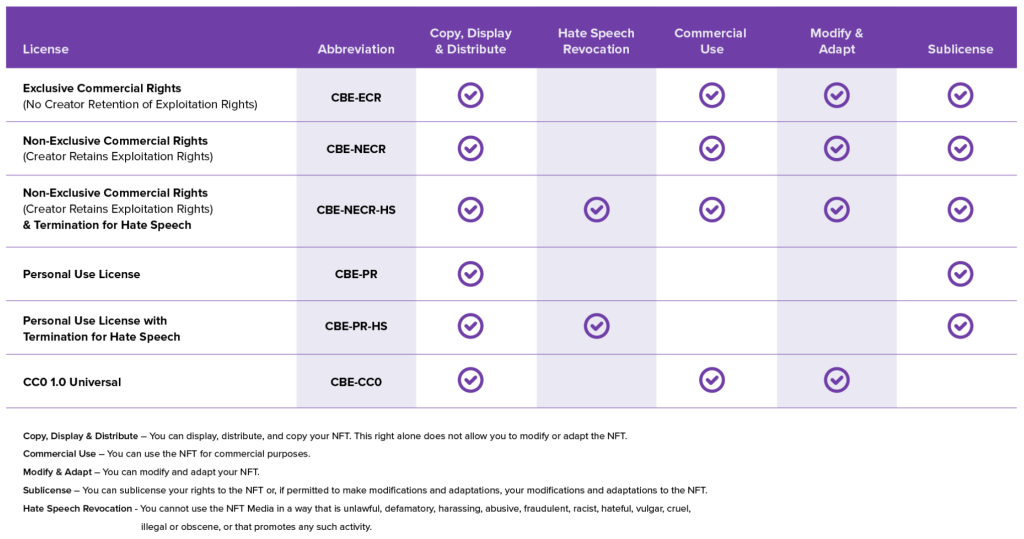
On August 31, 2022, VC powerhouse Andreessen Horowitz released a series of license templates focused on helping NFT projects create more certainty in intellectual property matters.  This comes on the heels of an August 19, 2022 report, “A Survey of NFT Licenses: Facts & Fictions” that concludes the “vast majority of NFTs convey zero intellectual property ownership” to their owners. 

Seeking to create certainty where none currently exists, the released licenses provide different approaches for NFT projects:

According to Andreessen’s Horowitz’s General Counsel, these licenses “were inspired by 20-plus years of work by the Creative Commons.”  Working with two law firms and several of their portfolio companies, the licenses have been incorporated into a Github repo so creators can build them directly into the smart contracts used in their NFT projects. And, they have been all released under the Creative Commons Zero open source license.  Andreessen Horowitz also claims that its licenses are “legally irrevocable” and create certainty in the marketplace after the license is deployed. 

All of this is of course wishful thinking. 

No matter how noble its motivations, Andreessen Horowitz cannot unilaterally dictate when licenses will be “legally irrevocable” in the same sense a smart contract deployed on one platform may not be enforceable when a minted NFT using that same smart contract is sold on another platform.  Given the many different NFT platforms deployed, this is just one of many issues that likely more pressing.  As for what a suitable NFT intellectual property framework would actually look like, that really depends on the platform used.

Frosties Rug Pull Demonstrates Community is Key to NFT Projects

On January 9, 2022, creators of the Frosties NFT Collection abandoned their project after investors spent over $1.2 million buying the entire inventory of digital “cartoon ice cream” characters. The money received by the creators was transferred the same day.

Relying on the Chinese lucky number 8 four times over, the collection of 8,888 Frosties was described as “Cool, Delectable, and Unique” and quickly sold out based on claims made by the creators.  Their project website – which has since been taken down, promises the following:

Frostie NFTs are made up of over a hundred exciting traits of backgrounds, body, clothing, eyes, mouths, eyewear, hats, toppings, and items. Each Frostie is a unique, non-fungible token (NFT) on the Ethereum blockchain.

Frosties will have staking, metaverse, breeding functions, and so much more!

Holding a Frostie allows you to become eligible for holder rewards such as giveaways, airdrops, early access to the metaverse game, and exclusive mint passes to the upcoming seasons.

The Frosties presale will take place on January 7th and the main sale will take place on January 8th.

Join the Frosties community on Twitter and Discord!

After the January 8, 2022 public drop of Frosties at a floor of 0.04 ETH, the project’s Twitter and Discord server accounts were taken down and in a “rug pull” the floor price was removed.  It was also a cash grab given the NFTs stayed with their new owners whereas the creators stopped all further efforts to build or benefit the community.

What happened next is instructive.  First, the value of the underlying NFTs have been selling both low and very high.  In other words, the market is now dictating the pricing and life goes on with how these assets are going to be priced.

As for moving forward with the project, the Frosties Rug Pull demonstrates that projects can go forward with or without the original creators.  The key is to have a passionate community and at least a few folks who can help lead the charge from a technical perspective. 

In the case of Frosties, someone named EsahcHslaw took charge and posted on reddit:  “We are wrapping Frosties under a new contract for those who want to continue to hold while the project kicks off again. Old dev won’t gain royalties this way. The community will own the funds. Community ran, doxxed multisig, roadmap, website, new Twitter. DM for DC server invite.” 

By removing the possibility of creators obtaining future royalties, Frosties owners effectively removed the creators from the project going forward.  And, if the Frosties community continues growing organically – with new social media channels and active community involvement, the Frosties Rug Pull will demonstrate that an active community is the primary engine for driving NFT value.

UPDATE: March 25, 2022

Federal prosecutors New York charged two in a criminal complaint with conspiracy to commit wire fraud and conspiracy to commit money laundering, in connection with the Frosties rug pull.

As set forth in the March 24, 2022 DOJ press release, “Mr. Nguyen and Mr. Llacuna promised investors the benefits of the Frosties NFTs, but when it sold out, they pulled the rug out from under the victims, almost immediately shutting down the website and transferring the money. Our job as prosecutors and law enforcement is to protect investors from swindlers looking for a payday.”

The DeFi End Game

A skilled chess player will tell you the best way to study chess at a high level is to first study endgames and truly learn the power of each piece.  Memorizing book openings generally comes last.  If one wants to learn about the insurance industry, first take a job in the claims department.  In a similar way, students of disruptive technologies benefit from first learning their “end game”.  

Blockchain is one disruptive technology that still has not fully discovered its business sea legs.  The purported proxy for blockchain – Bitcoin, recently hit all-time highs so naturally on January 3, 2021 a forecaster placed a ten-year target of $1 million on this speculative asset.   Every good bubble requires inflating and the very speculative Bitcoin bubble currently being massively inflated by hedge fund money is no different.   

Bitcoin’s bubble ascension does not mean, however, the seismic blockchain and distributed ledger technology (DLT) shifts taking place over the past five years in the financial industry have been illusory or should be ignored.  As previously recognized, “acceptance of blockchain technology by the financial industry will be indelible proof those mistakes of 1995 made by retail sales and marketing companies will not be repeated by the financial industry.” 

Over the past several years, financial titans have reluctantly come out swinging in favor of convertible virtual currency (CVC) transactions.  For example, most US PayPal customers now have the ability to buy, sell and hold four different cryptocurrencies – BTC, ETH, LTC, and BCH, and use them as a funding source with the company’s 26 million merchants.  Presently, PayPal’s maximum dollar amount for weekly CVC purchases is $20,000 but even that relatively high consumer amount will likely change upwards as Paypal moves up the financial transaction food chain – with Paypal’s Venmo next in line.

The largest bank in the United States – J.P. Morgan Chase, launched its JPM Coin in 2019, and in October 2020 set up an entirely new business, Onyx, as an umbrella for its blockchain and CVC initiatives – including JPM Coin.  According to Jamie Dimon, Chairman and CEO of J.P. Morgan:  “Onyx is at the forefront of a major shift in the financial services industry. This new business unit reflects J.P. Morgan’s commitment to innovation as we continue to build cutting-edge technology that delivers a better, faster and more inclusive financial system.” On December 10, 2020, J.P. Morgan announced it completed a live, blockchain-based intraday repo transaction using JPM Coin.  And, Visa has filed a patent application for what may seem perfunctory, namely recording digital currencies on a blockchain.

Apart from these blockchain-based efforts, there is a whole category of blockchain initiatives that will forever fundamentally alter the broader financial sector – to the likely chagrin of PayPal, J.P. Morgan, and Visa. The banner name for these new blockchain and DLT initiatives is “DeFi”, or decentralized finance.

In December 2019, the entire Total Value Locked (TVL) in the DeFi market was worth less than $700 million, by the end of December 2020 it grew to $14 billion, and as of January 5, 2021 the total TVL in DeFi was at over $19 billion and growing – representing a staggering growth trajectory.  The TVL in the DeFi market represents all DeFi projects but is largely driven by the lending platform MakerDAO – a decentralized credit platform supporting Dai, a stablecoin pegged to the US dollar.  Decentralized exchanges (DEXes) such as Uniswap largely make up the remaining bulk of projects.  DEXes enforce trading rules and execute trades without charging the high fees normally associated with alternative investment trades.   

A commitment of $19 billion to DeFi initiatives may seem miniscule compared to, for example, the over $6 trillion in foreign exchange trades conducted each day.   On the other hand, each DeFi transaction potentially empowers individuals while at the same time weakening the grip over the monetary system currently held by central banks and finance intermediaries – a true game changer by any measure.

Generally relying on the public Ethereum blockchain platform, most DeFi projects deploy smart contracts to automate what previously required human intervention – obviating the need for central authorities such as banks or intermediaries.  DeFi Pulse nicely showcases the benefits of DeFi by describing it as “money Legos” and giving the following example:

Compound is a money market or, in other words, a lending service on Ethereum. When you supply DAI to Compound, you receive cDAI tokens which represent both your DAI in Compound and any interest you’ve earned from lending. Since cDAI is a token, you can send, receive, or even use cDAI in other smart contracts. Money Legos in action: ETH into MakerDAO to mint DAI tokens, DAI being supplied to Compound, cDAI tokens can be used in other DApps.  For example, you can swap ETH for cDAI on a DEX and instantly start earning interest for just holding cDAI. And because you choose how you interact with smart contracts on the blockchain, you can use a DEX aggregator like DEX.AG to compare and trade at the best prices across all the popular DEXes, all within seconds.

In 2021, crowdfunding will help fund some of the DeFi startups looking to eventually disintermediate the more traditional financial firms these startups would otherwise approach for financing.   As of November 2020, online platforms can raise up to $5 million in seed capital in a State-preempted manner – with previous platforms raising hundreds of millions of dollars using the prior SEC Regulation Crowdfunding cap of $1.07 million.  Even though a typical crowdfunding online platform itself breaks away from traditional centralized banking platforms its success is not relevant for purposes of the DeFi initiatives potentially opened up by Regulation Crowdfunding.  What may be more relevant are the new ideas coming to market without the latent influence of legacy financing.  

Before widespread adoption of any DeFi product is even feasible, however, regulatory scrutiny will be needed to protect consumers onboarding these new DeFi applications.   Given that a CVC wallet is the exit ramp for many DeFi initiatives, it is no surprise that has been an area of regulatory interest.  For example, the US Treasury’s Financial Crimes Enforcement Network (‘‘FinCEN’’) recently proposed a rule that would require banks and money service businesses to file a report with FinCEN containing information related to a customer, their CVC transaction, and counterparty (including name and physical address) “if a counterparty to the transaction is using an unhosted or otherwise covered wallet and the transaction is greater than $10,000.” FinCEN is issuing regulations on transactions using digital currency wallets because the growth of individual CVC transactions will continue unabated.  

While providing a suggested Token Safe Harbor Proposal, SEC Commissioner Hester M. Peirce offered an excellent analysis of the “regulatory Catch 22” faced by decentralized networks looking to comport with SEC regulatory law. In addition to Commissioner Peirce’s forward thinking, the SEC also recently set free its FinHub as a separate office to assist blockchain and DLT innovators.  

Despite these technology-forward initiatives, the SEC continues placing an exclamation point on its regulatory reach. For example, the SEC last month shook the Ripple world by claiming in a lawsuit Ripple’s XRP token –  used by financial institutions around the globe, was an unregistered security.  It also ended the year by filing a Cease and Desist Order against ShipChain on similar grounds. These sort of efforts convey US regulators still corralling the blockchain stallion – albeit primarily through the Howey door. Disruptive DeFi initiatives should remain undeterred.

More urgent concerns for the DeFi community are coding bugs, double-spend exploits, traditional hacks, and any number of faulty implemented software functions caused when smart contracts fail to undergo adequate audits.  Despite only losing $50 million in 2020, malicious actors will certainly begin seeing a larger target over DeFi’s head as its growth continues.  Moreover, given most DeFi projects run on Ethereum, there are future threats not even widely discussed – such as those potentially arising from miners who map out transactions on a blockchain for a fee and who are no longer satisfied with just receiving their fees.

All of these potential risks – whether regulatory, technological, malicious, or competitive, however, remain dwarfed by the potential upside found in a successful, widely-adopted DeFi application or protocol.  One likely key to success is to replicate what companies such as PayPal chose to do – take a widely used existing tool and deploy into it a profitable new way that allows for flexibility with actual autonomy and consumer self-determination.  DeFi will ultimately go nowhere if it only brings into the fold insiders stuck in Moore’s early adopter phase.  

Moreover, no open-source project can ascend until a large enough market believes the tradeoffs between ease of use, financial benefits, and utility ring strongly in its favor.  For example, despite having a strong web server market position, a Linux desktop will never really threaten Microsoft’s foothold until the relevant commercial and consumer markets believe a Linux desktop truly meets all of their needs. 

Similarly, DeFi will never gain a foothold reaching above the “PayPalJPMVisa” mountain peak until at least one DeFi application checks all the relevant boxes for a sizable enough market.  It may be a decade before a DeFi project reaches that vantage point – with the classic Amazon vs. Sears endgame likely being studied along the way.